
A 17-Night Luxury Peru Itinerary with Belmond — The Complete Grand Tour
Updated: Oct 2
Our Advisor Notebook series takes you behind the scenes of the world's finest travel experiences — straight from the people who know them best. This post is the third in our Belmond Peru series. Parts 1 and 2 covered the individual destinations and properties in depth. This post does something different: it shows you what the complete journey looks like when it is all put together — every property, both trains, Colca Canyon, and Arequipa — built into a single, bookable itinerary for two.

Why this Luxury Peru Itinerary Belmond
Earlier this year, a client found us through an AI search on Perplexity. He had already done three versions of his own trip plan before he reached out — pricing, hotel categories, train schedules, altitude sequencing, the Andean Explorer. He had done his research. What he needed was someone who knew the Belmond collection from the inside and could make it happen. We helped them bring the itinerary to life with experiences, activities and more...
This post is the customized final itinerary.
The complete Belmond Peru Grand Tour: 6 regions, 17 nights
Each region has its own character and a specific role in the overall sequence:
LimaThe entry point, the food capital, the decompression before altitude.
The Sacred ValleyThe acclimatization stage. At 9,400 feet, it prepares the body for Cusco — and it is one of the most archaeologically extraordinary places on Earth.
Machu PicchuThe singular experience that needs no introduction with various challenging booking decisions.
CuscoThe Inca capital, with two Belmond hotels that serve very different travelers.
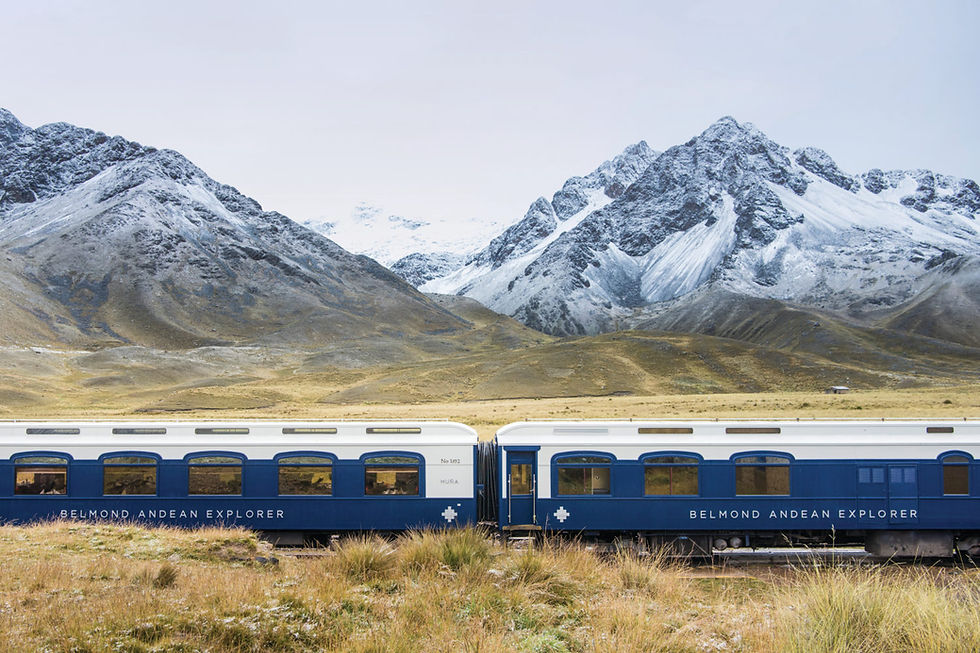
The Andean ExplorerSouth America's only luxury sleeper train, connecting Cusco to the altiplano and beyond.
Colca Canyon & ArequipaThe second Peru most international travelers never reach — and the part of the journey that tends to stay with people longest.
The sequence matters. Lima first, valley before city, train after Cusco. The altitude logic is built into the order. Reversing it is possible — but inadvisable.
17-night Belmond Peru itinerary — day by day
Days 1–3: Belmond Rio Sagrado, Sacred Valley — acclimatization and archaeology
The journey begins not in Lima but in the Sacred Valley — a deliberate choice. Flying Lima to Cusco on arrival day and driving straight to the valley means beginning acclimatization at 9,400 feet rather than 11,200. That 1,800-foot difference is meaningful. Travelers who begin in the valley arrive in Cusco days later having already adapted. Those who go straight to Cusco often spend their first day there recovering.
Belmond Rio Sagrado sits on the banks of the Urubamba River. Twenty-one rooms and two villas. The property is intimate by design — river sounds, mountain views, and a landscape that begins the process of disconnecting. It is not a dramatic arrival. It is a quiet one.

The three days here are full. Day one brings the Pisac market and a textile center where weavers from more than twelve communities demonstrate techniques that have not changed in centuries. Day two covers Ollantaytambo and the Moray agricultural terraces — concentric circles carved into the hillside, believed to have functioned as an Inca laboratory for testing growing conditions across altitudes. Lunch at Unu Restaurant in the Tiobamba community. Maras salt pans in the afternoon. Day three is lighter: kayaking at Huaypo lagoon, followed by a picnic lunch at the water's edge.
Three days in the Sacred Valley provides a great blend of relaxation and discovery.
Day 4: Belmond Sanctuary Lodge — the only hotel at Machu Picchu
On the fourth morning, a private transfer to Ollantaytambo train station. The train to Machu Picchu is the Vistadome — panoramic windows on all sides, the valley dropping away as the train descends into the cloud forest.

Sanctuary Lodge is the only hotel at Machu Picchu itself. Every other property in the area is twenty minutes below in Aguas Calientes. This is not a minor distinction. It is the difference between walking to the citadel entrance in the morning and spending that morning in a bus queue.
One night at Sanctuary Lodge is the standard. The morning arrival gives you the afternoon at the
citadel. The following morning you are back at the entrance before most visitors have left Aguas Calientes. Then the return train — the Hiram Bingham. Dinner on board, pisco, live musicians, the valley rising back toward Cusco in the dark. Our recommendation: take the Vistadome up and the Hiram Bingham back. Going up, the citadel is the destination. Coming back, the Hiram Bingham extends the day rather than front-loading it. Arrival at Poroy station approximately 10:00 PM.
Machu Picchu circuits explained: Circuit 1, 2, and 3 (2026)

Since June 2024, Peru's Ministry of Culture has organized all visits into three official circuits. Visits are one-way — each ticket is tied to a specific circuit, date, and entry window. Understanding the difference before you book matters. Its important to book your tickets in advance.
Circuit 1
Panoramic
Active / hikers
Upper terraces only. The wide cinematic view. Least crowded. Access point for Machu Picchu Mountain (year-round) and the Sun Gate in high season. Does not enter main temple zones.
Circuit 2
Classic
Most popular
Most comprehensive. Guardian's House, iconic viewpoint, Main Plaza, Sacred Rock, principal temple zones. Right for first-time visitors. Sells out furthest in advance — book early.
Circuit 3
Royalty
Most accessible
Ground-level route. Temple of the Sun, lower agricultural sectors. Less elevation change. Access point for Huayna Picchu and Huchuy Picchu — both sell out months ahead.
Days 5–6: Belmond Hotel Monasterio, Cusco — city tour and cooking class
Cusco sits at 11,200 feet. It deserves respect. Two nights here is the standard — enough to feel the city properly, enough to let the altitude settle, and enough for the two experiences that define Monasterio as more than just a place to sleep.

Belmond Hotel Monasterio is a former 16th-century monastery — colonial architecture, religious art, centuries of history in every corridor. It feels like living inside a museum. Oxygenated rooms are available in specific categories and must be booked in advance. This is not optional at altitude. It matters.
Day five is the city. A morning at leisure — the altitude warrants it — followed by a half-day tour in the afternoon: the Renaissance-style cathedral on Plaza de Armas, Santo Domingo Temple built on the foundations of the Koricancha Inca temple, the fortress of Sacsayhuamán outside the city, and Q'enqo — meaning labyrinth — where artfully carved rock reveals complex patterns of steps, seats, geometric reliefs, and a puma design.
Day six is the one that surprises people. The morning begins at San Pedro market — Cusco's central market, chaotic and vivid — where a Monasterio chef leads a tour of the Andean produce that defines the regional kitchen. Back at the hotel, a cooking lesson using the ingredients selected at the market, followed by a three-course dinner built around what was made, and a cocktail prepared by the hotel bartender using local fruits. It is the kind of experience that sounds like a hotel amenity and turns out to be a genuine afternoon.
Day seven begins the transition south. A shared transfer to the train station at 9:15 AM. The Andean Explorer departs at 11:00.
Days 7–9: The Andean Explorer — Lake Titicaca and the altiplano
The Andean Explorer is South America's only luxury sleeper train, operating year-round except February. Suite category. Everything included: all meals, the bar throughout, all excursions — speed boats to the islands of Lake Titicaca, buses, guides, transfers. The only additional cost is the spa.

The journey south from Cusco crosses the altiplano — vast, wind-swept, almost entirely unpopulated. A stop at Raqch'i, an archaeological site most travelers never visit. La Raya pass at over 14,000 feet — sundowners on the platform as the altiplano stretches away in every direction. Then dinner on board as the train continues south through the dark. The train sleeps overnight at Puno station. Travelers wake to sunrise over Lake Titicaca.

Day eight is the lake: the Uros floating islands — entire communities built on platforms of totora reeds on the highest navigable lake in the world — and Taquile Island, with a community lunch prepared by local families. Belmond works directly with these communities. The lunch is a genuine shared meal. It is not a performance. Stars at this altitude, in this landscape, are staggering.
Day nine: sunrise over a high-altitude lake, breakfast on board, a stop at the Sumbay Caves — over
500 ancient paintings and engravings of local wildlife. Then the fork in the journey. At KM 93 station: disembark. Private transfer to Las Casitas del Colca, ninety minutes by road. The travelers who continue to Arequipa by train miss this. It is worth disembarking.
Days 9–11: Las Casitas del Colca — condors, canyon, and the rim breakfast
Colca Canyon drops nearly 3,400 meters from rim to river — more than twice the depth of the Grand Canyon. Las Casitas del Colca sits on the rim. Each casita has its own private plunge pool. The main attraction is breakfast.
Breakfast is set up at the canyon's edge. The condors — the largest flying birds in the Western Hemisphere, with wingspans approaching ten feet — rise on the morning thermals from the canyon floor. They appear at roughly the same time each morning. The experience of sitting at a table at the edge of one of the world's great natural wonders, with those birds in the air directly in front of you, is one of the moments that stays with travelers for a long time.
Day ten: an early departure for the Condor's Cross — the best vantage point for watching condors in flight. A drive through the valley, Maca and Yanque with their colonial churches, and the Antahuilque Viewpoint. Afternoon at leisure. Two nights at Las Casitas is the right amount. One is not enough.
Days 11–13: Arequipa and Cirqa — Peru's White City
From Las Casitas, a transfer to Arequipa — Peru's second city, built almost entirely from sillar, white volcanic stone. Three volcanoes frame the horizon: El Misti, Chachani, and Pichu Pichu. The hotel is Cirqa — a beautifully restored colonial building, one of the newer luxury properties in Arequipa. Two nights, a Bóveda Room.
Arequipa's food scene is one of Peru's best-kept secrets — a regional cuisine that bears almost no resemblance to Lima's. Day twelve is the city tour: Plaza de Armas, the Jesuit cloisters, the suburbs of Yanahuara and Carmen Alto with views of El Misti, and the Santa Catalina Convent — a 16th-century nunnery that functioned as a city within a city for centuries. One of the most extraordinary historic sites in South America, and one that receives a fraction of the attention given to Machu Picchu.
Days 13–16: Belmond Miraflores Park, Lima — the return to sea level
A flight from Arequipa to Lima. Three nights at Belmond Miraflores Park — the return to sea level, and to the city that has become one of the world's great culinary destinations. Five restaurants in the global top 50. Eight in the Latin American top 50. Book the restaurants when you book the flights.
Lima used to be a connection point. It is no longer that. Miraflores Park sits one block from a major avenue on a quiet, traffic-free street overlooking a park, with Pacific Ocean views beyond. It is, as Erika Toro of Belmond Peru described it, "like a little island."
Day fourteen is the Lima city tour: Plaza Mayor, the cathedral, the Government Palace, and the Larco Museum. Day fifteen is Barranco — Lima's artsy, bohemian district, the Bridge of Sighs, the Pedro de Osma Museum, and Las Pallas, a craft store run by Mari Solari, who has lived in Peru for over forty years and has built what is arguably the finest collection of Peruvian folk art available for purchase anywhere in the country. Day seventeen: transfer to Lima airport. The journey ends.
Belmond Bellini Benefits
The Bellini Club benefit at every Belmond property means daily breakfast for two, a $90 hotel credit per stay (or $200 at suite-category properties), a welcome amenity, and priority consideration for upgrades — at no additional cost over the hotel's direct rate.
Practical details: altitude, tickets, and what to book first
The Andean Explorer runs year-round except February. The itinerary shown here runs in July — the heart of Peru's dry season, the most reliable weather window.
Oxygenated rooms at Monasterio must be booked in advance, in specific room categories only. Not optional at 11,200 feet.
The Sanctuary Lodge situation remains fluid. Book it, hold a backup in Aguas Calientes, and carry trip interruption insurance.
Machu Picchu entrance tickets are non-refundable and non-transferable. Book your tickets in advance as they sell out during peak times.
Altitude is cumulative. The sequence on this itinerary is designed around altitude management. Changing the order changes the experience.
Book Lima restaurants at the same time as your flights. The best tables fill weeks in advance. This is not an exaggeration.
Travel insurance is essential — medical evacuation and trip interruption coverage specifically.
Frequently asked questions
How long does the complete Belmond Peru Grand Tour take?
This Luxury Peru itinerary with Belmond is Seventeen nights. A shorter version — skipping the Andean Explorer, Colca Canyon, and Arequipa — can be done in ten to twelve nights and is covered in Parts 1 and 2 of this series.
Is seventeen nights realistic for most travelers?
It depends on the traveler. For those with the time, it is the right amount. For those with ten or twelve nights, the priority is Lima, Sacred Valley, Machu Picchu, and Cusco. The Andean Explorer and Colca Canyon can be added on a return trip. Peru rewards return visits.
Which Machu Picchu circuit should I book?
For first-time visitors, Circuit 2 — the Classic Circuit — is the right answer almost every time. For Huayna Picchu or Huchuy Picchu, Circuit 3 is the access point. For the panoramic view with a lighter walk, or to add the Machu Picchu Mountain hike, Circuit 1. Your Sanctuary Lodge concierge can advise based on fitness level and priorities on the day.
Which Cusco hotel — Monasterio or Palacio Nazarenas?
This itinerary uses Monasterio. For an all-suite property with every room fully oxygenated, a plunge pool, and dining led by Pia León — named best female chef in the world in 2022 — Palacio Nazarenas is the alternative. For travelers who want to feel history in every stone, Monasterio is the right choice.
What is Cirqa, and why is it the Arequipa hotel on this itinerary?
Cirqa is one of the newer luxury properties in Arequipa — a beautifully restored colonial building. It is not a Belmond property, but it is the right hotel for Arequipa.
What perks do I get booking through Elli Travel Group?
As a Belmond Bellini Club partner, Elli Travel Group travelers receive daily breakfast for two, a $90 hotel credit per stay, a welcome amenity, and priority consideration for upgrades at every Belmond property worldwide — at no additional cost over the hotel's direct rate.
Why use a luxury travel advisor for Peru?
This itinerary involves five properties, two trains, domestic flights, private ground transfers, altitude sequencing, Machu Picchu ticket logistics, and a property with an active licensing situation. There is no additional cost to working with Elli Travel Group, and the Bellini Club perks across five Belmond stays represent meaningful value. The complexity alone makes an advisor the practical choice. The perks make it the obvious one.
The Elli Travel Group advantage
Our team has built this journey for real clients. We know the train decisions, the altitude sequencing, the property comparisons, and the Sanctuary Lodge situation as it continues to evolve. We handle every detail — from your arrival to the final transfer to the Lima airport — so that when you watch the condors rise from Colca Canyon at dawn, all you have to do is look up.
More Belmond Peru Inspiration | Read Next
Luxury Travel in Peru with Belmond: The Andean Explorer, Lake Titicaca, Arequipa & Las Casitas del Colca: Learn more about an additional Peruvian Extension with the Belmond Andean Explorer.
Belmond Peru Hotels: A Property-by-Property Guide: Learn more about Belmond's unique hotels and locations
Luxury Travel in Peru with Belmond: Lima, Sacred Valley & Machu Picchu: Learn more about Belmond's Peruvian Portfolio.
Peru is extraordinary. The complete journey is something else entirely. Reach out to our team and let's get started.
Comments