
Luxury Travel in Peru with Belmond: The Andean Explorer, Lake Titicaca, Arequipa & Las Casitas del Colca
Updated: Oct 2
Our Advisor Notebook series takes you behind the scenes of the world’s finest travel experiences — straight from the people who know them best. This is Part 2 of our Belmond Peru series with Erika Toro, Director of Sales for Belmond Hotels in Peru. In Part 1 we covered Lima, the Sacred Valley, Machu Picchu, and Cusco. Here we continue the journey south and west — aboard one of the world’s great trains, across the highest navigable lake on Earth, into one of South America’s most dramatic canyons, and through the white city of Arequipa.
The Other Peru: Why This Journey Exists
Most travelers who visit Peru see Lima, the Sacred Valley, Machu Picchu, and Cusco. That itinerary is extraordinary — and it is covered in depth in Part 1 of this series. But there is a second Peru that relatively few international travelers reach, and it is, in many ways, even more singular.
The altiplano — the high plateau that stretches south and west of Cusco — is one of the most remote and visually overwhelming landscapes on Earth. Vast, wind-swept, and almost entirely unpopulated, it sits at altitudes that make Cusco feel low by comparison. Lake Titicaca, the largest lake in South America and the highest navigable lake in the world, shimmers at 12,500 feet. Colca Canyon, one of the deepest canyons on the planet, drops nearly two miles from rim to river. And Arequipa — the White City — sits at the foot of three volcanoes, with a food culture and architectural heritage entirely its own.
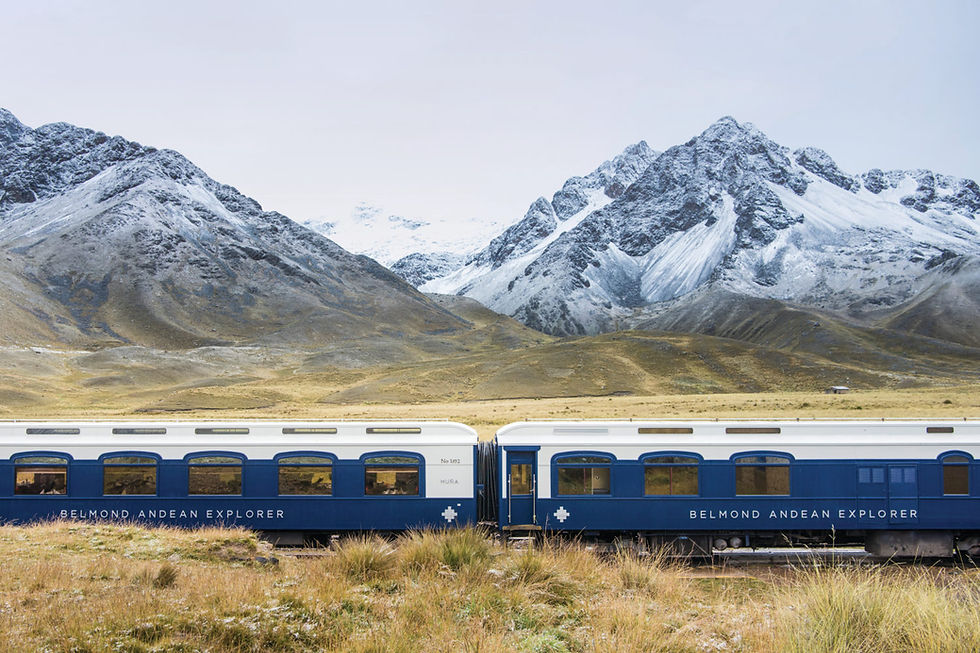
The best way to experience all of it is aboard the Andean Explorer — Belmond’s sleeper train, and one of the most extraordinary rail journeys in the world.
“This is the most amazing train,” Erika told us — and having heard her describe every stop, every landscape, and every moment of the journey, it is difficult to disagree.
The Andean Explorer: South America’s Only Luxury Sleeper Train

The Andean Explorer is the only luxury sleeper train in South America, and it operates year-round with the exception of February — the region’s lowest rainfall month and the one period when the train does not run.
The journey takes three days and two nights, covering the stretch between Cusco and Arequipa with an overnight stop in Puno on the shores of Lake Titicaca. All meals are included, the bar is open throughout, and every excursion — speed boats to the islands of Lake Titicaca, buses, guides, and transfers — is covered. “You don’t have to worry about anything,” Erika told us. “The only thing with extra cost is the spa.”

The train currently offers twin cabins and suites. Twin cabins are priced at approximately $7,000 per cabin for two nights — a figure that includes everything described above. Suites run approximately $10,000. A renovation project is currently underway to convert bunk-bed cabins into additional suites, which will further elevate the onboard experience in the coming seasons.
The Journey: Stop by Stop
Cusco to Puno: Across the Altiplano. The Andean Explorer departs Cusco and begins its long climb
onto the altiplano. The first stop is a relatively unknown archaeological site between Cusco and Puno that most travelers never visit, simply because it is too far from the standard tourist circuit. The second stop is La Raya — a mountain pass at approximately 4,300 meters, or just over 14,000 feet. Here the train pauses for a sundowner — drinks on the platform as the altiplano stretches away in every direction. The train then moves through the night, arriving at Puno station and sleeping on the tracks. Travelers wake to sunrise over Lake Titicaca.

Lake Titicaca: The Islands
The morning in Puno is spent on the lake. Speed boats take travelers out to two distinct island experiences — each with its own character and significance.
The Uros Islands are the famous floating islands, constructed entirely from totora reeds by the Uros people who have lived on the lake for centuries. The engineering is remarkable — entire communities built on platforms of compressed reeds, floating on a lake at altitude in one of the most remote parts of South America.
Taquile Island offers something different — a rocky, terraced island with a beach and a community lunch prepared by local families, using ingredients grown on the island and fish from the lake. Belmond works directly with these communities, and the lunch is a genuine shared meal rather than a tourist performance.
The afternoon returns travelers to the train, which begins moving south through increasingly dramatic terrain — crossing between two high-altitude lagoons as the altiplano passes in the darkness outside.
The Night Passage: Between Two Lagoons
The overnight section between Puno and the south is the stretch that gives the Andean Explorer its most otherworldly quality. The train crosses the Peruvian Andes in the dark — high mountains, nothing else — and the stars at this altitude, in this landscape, are staggering. Two stops punctuate the night: the first at Zumba, where passengers can step off to visit nearby caves; the second a junction point where the journey divides.

The Fork in the Road: Arequipa or Las Casitas del Colca?
Option 1 — Continue to Arequipa: Travelers who continue to Arequipa stay on the train through to the city, arriving with time for a panoramic tour before transferring to a hotel or the airport for the flight back to Lima. Arequipa includes an additional lunch on board — and the food here is entirely different from anything encountered earlier on the journey.
Option 2 — Disembark for Las Casitas del Colca: For travelers with additional time, the stop closest to Las Casitas del Colca is one hour and thirty minutes from the property by road — making it the most natural and efficient way to reach one of Belmond’s most extraordinary destinations. From Arequipa itself, the drive takes approximately three hours, so the train stop is a meaningful advantage.
Las Casitas del Colca: Breakfast at the Edge of the World
Colca Canyon is the third deepest canyon in the world. Cut by the Colca River over millions of years, it drops nearly 3,400 meters from rim to river — more than twice the depth of the Grand Canyon. It is also remarkably green and lush — terraced by pre-Inca civilizations whose agricultural engineering still marks the canyon walls, and home to condors that ride the thermal currents rising from the canyon floor.

Belmond’s Las Casitas del Colca sits on the rim. Each casita has its own private plunge pool. The main attraction, though, is breakfast.
“We set up breakfast at the canyon,” Erika told us. “You see how high it is — and you can see the condors fly.”
The image she described is one of the most evocative in this entire series: a table set at the edge of one of the world’s great natural wonders, breakfast laid out as the sun rises over the canyon walls, and Andean condors — the largest flying birds in the Western Hemisphere, with wingspans of up to ten feet — rising on the morning thermals directly in front of you.
“It’s like a show,” Erika said. “The condors seem like they know the people go there to see them.”
Beyond breakfast, Las Casitas offers horseback riding along the canyon rim, bicycle tours through surrounding villages, yoga, and visits to local communities. The pace is slow and deliberate — a final decompression before the journey back to Lima and home.
Arequipa: The White City
Whether arriving by train or by road from Las Casitas, Arequipa deserves at least a day. Peru’s second city is built almost entirely from sillar — a white volcanic stone quarried from the surrounding mountains — giving it a visual character unlike any other city in South America. Three volcanoes frame the horizon: El Misti, Chachani, and Pichu Pichu.
The food scene in Arequipa is one of Peru’s best-kept secrets. Regional specialties bear almost no resemblance to the cuisine of Lima — it is a completely different culinary tradition. Erika noted that Arequipa’s food is “totally different from the rest” of Peru — which, given how extraordinary the rest of Peru’s food is, is a meaningful statement.
Two newer properties in Arequipa are worth knowing about: Cirqa, from the same group as Titilaka on Lake Titicaca, and Palacio Waqui, a beautifully restored colonial palace.
How to Build the Complete Belmond Peru Journey
Belmond offers a Grand Tour of Peru package — a structured itinerary configurable in several ways depending on priorities and available time. A suggested framework: two nights in Lima, two nights in the Sacred Valley, one night at Sanctuary Lodge for Machu Picchu, three nights in Cusco split between Monasterio and Palacio Nazarenas, then south on the Andean Explorer to Lake Titicaca, Arequipa, and — for those with time — a final chapter at Las Casitas del Colca.
The full journey, done properly, takes between ten and thirteen nights. It is one of the great luxury itineraries in the world.
Erika also noted that Peru is increasingly popular among repeat travelers — those who visited Machu Picchu years ago and are returning with different priorities. “They now want to do it in a more upscale way,” she told us. “Lima because of gastronomy, Palacio Nazarenas, the train, and Colca Canyon.” For travelers who think they have done Peru, Belmond’s collection has a way of showing them they have only just begun.
Practical Details Every Traveler Should Know
The Andean Explorer runs year-round except February. February is the lowest month for travel in the region and the one period when the train does not operate.
Two nights is now the minimum booking. The one-night option has been discontinued. The change ensures both key overnight sections — previously missed when the train moved at night — are experienced properly.
Las Casitas del Colca is three hours from Arequipa by road. The most efficient way to include it is to disembark from the Andean Explorer at the junction stop — one hour and thirty minutes from the property — rather than continuing to Arequipa and driving back.
Altitude remains a consideration throughout. La Raya pass reaches over 14,000 feet. Lake Titicaca sits at 12,500 feet. Follow the recommended sequencing — beginning in Lima, moving to the Sacred Valley, then to Cusco — and the altitude becomes manageable rather than overwhelming.
Travel insurance is essential. The remoteness of several destinations on this itinerary makes comprehensive coverage — including trip interruption, cancellation, and medical evacuation — non-negotiable.
Book Lima restaurants at the same time as your flights. The best tables in Lima fill weeks or months in advance.
Frequently Asked Questions About Belmond Peru
How long do I need for the full Belmond Peru experience?
A minimum of ten nights covers Lima, the Sacred Valley, Machu Picchu, and Cusco comfortably. Adding the Andean Explorer and Arequipa extends the journey to approximately twelve nights. Including Las Casitas del Colca brings it to thirteen.
What is the best time of year to visit Peru?
The dry season — May through October — is Peru’s peak travel period. The green season — January through April — brings more rainfall but lush landscapes, fewer crowds, and the exclusive Hiram Bingham departure from Rio Sagrado.
Is the Andean Explorer suitable for families?
The Andean Explorer is best suited for adults and older teenagers. For families with younger children, the focus is better placed on Lima, the Sacred Valley, and Cusco.
Should I take the Hiram Bingham to Machu Picchu or back?
Erika’s recommendation is to take the Vistadome on the way up and the Hiram Bingham on the return, when the celebration dinner, open bar, and live music extend the magic of the day.
What perks do I get booking Belmond Peru through Elli Travel Group?
As a Belmond Bellini Club partner, Elli Travel Group travelers receive daily breakfast for two, a $90 hotel credit, a welcome amenity, and priority consideration for upgrades — all at no additional cost over the hotel’s direct rate.
Why should I use a luxury travel advisor for Peru?
Peru’s Belmond collection involves multiple properties, two trains, altitude considerations, and logistical decisions that genuinely benefit from expert guidance. There is no additional cost to working with Elli Travel Group, and the perks are meaningful.
The Elli Travel Group Advantage
Peru is one of the world’s truly great luxury journeys — and the Belmond collection is the finest way to experience it. As a Belmond Bellini Club partner, Elli Travel Group travelers receive exclusive amenities across every Belmond property in Peru, including daily breakfast for two, a $90 hotel credit, a welcome amenity, and priority consideration for upgrades — all at no additional cost over the hotel’s direct rate.
Our team knows this collection from the inside — the train decisions, the altitude sequencing, the property comparisons, and the Sanctuary Lodge situation as it continues to evolve. We handle every detail so that when you board the Andean Explorer and watch the altiplano unfold outside your window, all you have to do is look out.
Peru Inspiration | Belmond Peruvian Itinerary
Luxury Travel in Peru with Belmond: Lima, Sacred Valley & Machu Picchu Learn more about the classic Peruvian itineary with Belmond Peru.
Belmond Peru Hotels: A Property-by-Property Guide: Learn more about Belmond's unique hotels and locations
A 17-Night Luxury Peru Itinerary with Belmond — The Complete Grand Tour Learn about the perfect 17 Night Belmond Peru Tour.
Peru is extraordinary. Let’s make sure you experience all of it. Reach out to our team and let’s get started.


Comments